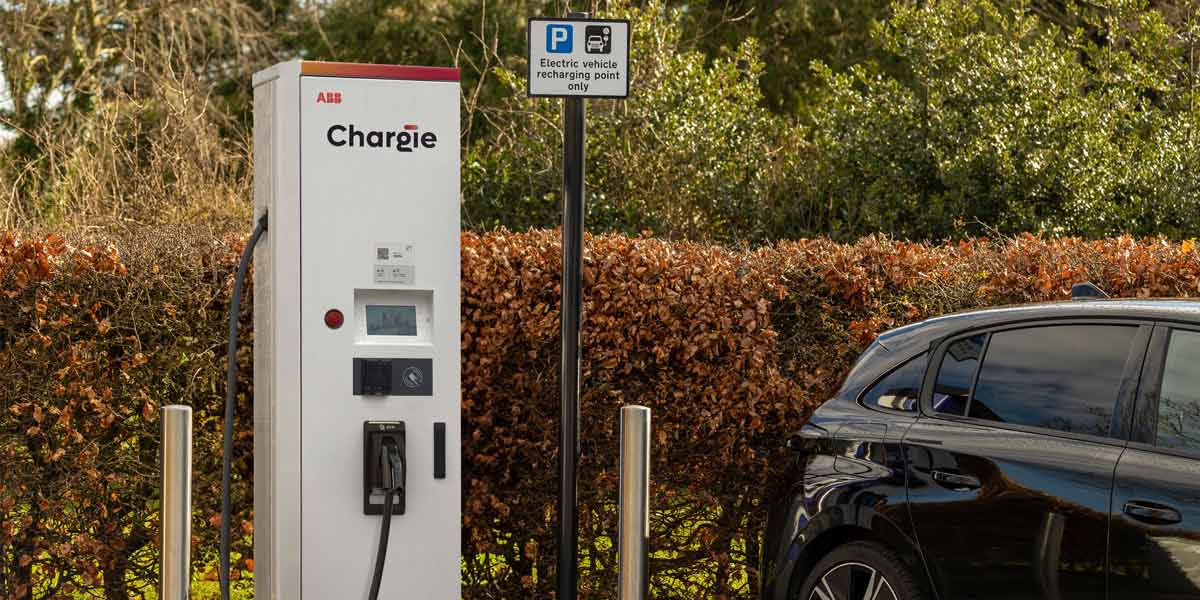
A Beginner's Guide to EV Charging Terminology. In a world of many acronyms and abbreviations, here is your guide to the EV industry.

General term for any vehicle powered entirely or partially by electricity. Includes BEVs, PHEVs, HEVs.
Vehicles that combine an internal combustion engine with a rechargeable battery that can be charged via an external power source. PHEVs allow for short all-electric trips while also offering the flexibility to use gasoline for longer distances, making them a good transitional option for drivers making the switch to electric.
The most common type of EV, they are fully electric and powered by a rechargeable battery.
Combines a gasoline engine with an electric motor; however, they differ from PHEVs since they cannot be plugged in; rather their battery is recharged through regenerative breaking and the engine.
Uses a hydrogen fuel cell rather than a battery to generate electricity, emitting only water vapor and heat.
Any vehicle that does not emit tailpipe pollutants; includes BEVs and FCEVs.
ICE vehicles utilize a traditional engine powered by gasoline or diesel.
The technical term for EV charging equipment and hardware.
Charging method that uses the vehicle’s on-board converter to change alternating current into direct current that can then be used to charge the vehicle’s battery. AC chargers are best for long-dwell or overnight locations, like a driver’s home and workplace since they take longer.
Learn more about AC from our blog article: What is the Difference between AC vs DC Charging? | Chargie
Charging method that provides quicker charging than AC chargers since they directly supply the battery with the DC current, bypassing the need for a conversion. DC chargers are traditionally used for public and commercial charging, providing drivers with a quick, stop and go experience.
Learn more about DC from our recent blog article: What is the Difference between AC vs DC Charging? | Chargie
The slowest level of charging. These chargers plug into a standard 110–120-volt power source, like the standard outlet in your home. L1 chargers may take 12-20 hours to fully charge an EV from empty.
~1.4-1.9 kW, which averages to 3-8 miles per hour
Uses a higher-output 208–240-volt power source (one for larger appliances like an oven or dryer). Our L2 chargers use a J1772 plug and can charge an EV from 10% to full battery in 5-7 hours. L2 chargers are perfect for overnight and long-dwell locations, like a driver’s home or workplace.
~6.2-19.2 kW, which ranges from 15-30 miles per hour.
L3s/DCFCs can charge 10x – 50x faster than L2 chargers, fully charging a vehicle in 30 minutes to 1 hour. They support CCS, NACS, and CHAdeMO plugs, and are usually found in public and commercial locations, for drivers looking for a stop and go charging experience.
~50-350kw+, fully charging most EVs in under an hour
Also known as J plug, Type 1 connector, or simply J1772, this is the standard connector for Level 1 and Level 2 charging in North America.
Supports both AC and DC charging. CCS ports build upon the J1772 connector, adding two additional pins for high-speed DC charging compatibility.
Older fast charging standard, primarily used with Japanese EVs (Nissan and Mitsubishi).
Most commonly used for fast chargers across North America but can support both AC and DC charging. It was developed by Tesla.
Allows compatibility between different charger plug types and vehicle connectors.
A common unit of measurement of electricity.
One kilowatt is equal to one thousand watts (W).
Composite unit of energy equal to one kilowatt (kW) of power sustained for one hour. EV battery charge is measured by this metric.
Derived unit for electrical potential, electric potential difference (voltage), and electromotive force.
The base unit of electric current in the International System of Units (SI). It measures the amount of electricity used.
How far a vehicle can travel on a single battery charge.
Standalone residential units.
Residential buildings that house multiple, separate households within a single structure or complex.
The State of California’s Public Utilities Commission defines a disadvantaged community as the areas which most suffer from a combination of economic, health, and environmental burdens.
A group of vehicles owned or operated by a business, government, or organization.
Business or mixed-use properties like office buildings, retail centers, hospitals, airports, hotels, and campuses.
A method where multiple chargers share available electrical capacity.
Learn more here: Load Sharing and EV Charging Load Management Explained
Smart technology that allows bidirectional charging between the vehicle and electricity grid, meaning compatible vehicles can draw power to charge and also send electricity back to the grid when needed.
The international standard that defines communication protocols or pathways between EVs and EV charging stations. More simply put, it gives EVs, EV chargers, and ultimately the electrical grid, the ability to speak and relay information back and forth to each other.
Learn more here: What is Plug & Charge or ISO 15118 for EV Charging Stations
Method select vehicles utilize to capture and convert kinetic energy from braking back into electrical energy stored in the battery.
Feelings of anxiety around charging infrastructure and fear an EV will run out of charge due to a lack of adequate charging infrastructure.
Range Anxiety for EV Drivers: What Is It and How to Avoid It?
Include credits for new and used EVs, as well as financial benefits for charger installations.
Check our rebates and incentives page to find rebates in your area: EV Charging Rebates and Incentives: Find the Right Program
Broadly refers to a set of socially constructed rules EV drivers should follow to keep EV charging stations accessible and available for everyone.
CARB is a government organization focused on reducing air pollution and deploying programs and actions to fight climate change.
Learn more here: California Air Resources Board
California’s low carbon fuel standard program aims to decrease the carbon intensity of sold transportation fuels in the state through 2030 and encourage renewable alternatives. The program is regulated by CARB.
Learn more here: Low Carbon Fuel Standards CARB
The CEC is California’s leading energy policy and planning agency. The commission works towards building a greener, more sustainable future for generations to come.
Learn more here: California Energy Commision
Formed in 1970, the U.S. Environmental Protection Agency strives to protect public health and the environment. To fulfill this mission, EPA conducts and supports industry-leading research, provides free and informative data to the public, and develops and enforces policies.
Learn more here: Environmental Protection Agency